Mostrando las entradas para la consulta malingas ordenadas por relevancia. Ordenar por fecha Mostrar todas las entradas

lunes, 24 de junio de 2019

Eberything begins with a click

Original prompter  of my presentation to the Piura’s Regional Council of Youth, October 13th, 2014. Edited and translated by the author.


Thanks for having me, and I hope to give you  useful information, if not you bull me at the time of the questions. How to do marketing on the social media? The key of everything is making a click. Of course, making a click is the easy part. The complicated is to build all the strategy that becomes that magic moment meaning a click. But making a click has few magic and much science, indeed.


First, let’s define  what marketing is. In simple terms it’s the ability that I have to satisfy a need of the people in any field, so they ever continue to choose me. Said simple – it’s the art of selling. We offer a good or a service through every sale in exchange of another good or service. The trick is in the verb to offer. Because it’s not the same to say “buy those potatoes” instead to say, for example: “Make your family to enjoy tonight – put some Piura’s fried potatoes to your crispy chicken.” Essentially, we’ve said the same. The difference is in how we present it, and how this presentation satisfies a need of the people.


The Malingas Initiative
Well, what do the social media have to do in all this?I learned how to edit webpages for myself 14 years ago. When I thought to have some experience on the issue, I decided to launch my personal website in September 2000, and one month later I launched FactorTierra, what we call FACTORTIERRA.NET now. The most of our coverages has been social-environmental conflicts, until an interesting door opened to us in December 2008.


After a problem related to  natural resources predation in Malingas, Tambogrande, story we became to release, a community’s leader sat down with my crew in March 2009 and made us a challenge: to put Malingas on the map. For making that, the first we realized was to research in-depth how this community is, so we spent a full week living with it. Initially, we were  to focus on the agriculture and cattle topic, what was that you could see straight, until ending the first day of research, Luis Correa, one of the producers, came back with news: a new petroglyph. Who knows Malingas, its best known archaeological vestige is The Devils of Guaraguaos Alto. But, what Luis Correa was saying to me was we had more sites.


Because of his insistence, we got an archeologist who we started to research with by our own, and we found, at least, a dozen of archaeological sites in a 200-sq-km area. The evidences we got to gather set that the petroglyphs could be until 4000 years old. Only as a reference, Chavín is 3200 years old. With all this information, we began to build a microsite you can visit, now if you want, on http://www.factortierra.net/malingas


When we closed the research in 2011, we decided to pack all those sightings on an article that made viral. In May that year, we released El secreto de Malingas (The Secret of Malingas), that was first ranked by RPP Noticias and Radio Cutivalú, and what came later was a load tthat included Andina News Agency, that is the official news agency of Peru, and other media across the nation and abroad. In the next two days, the story of the 4000-year-old petroglyphs in Malingas went around the globe, literally. The challenge that they imposed to our crew, to put Malingas on the map, was gotten, at least in a first step.


(An award to the) identity
And wwhat was the secret of Malingas? The truth is that the secret was seen for everybody: its own identity. We all have our own identity, or we should have it. The same happens to the products. And if we understand Malingas as a product, then the first one we have to look for is the own identity, I mean what makes it unique in the world and different to the rest. And when you bet to the identity, you make a trend.


Obviously, we put the link to the original article and the rankings on Facebook, and they had too likes and shares that it almost made pretty viral. For Malingas, it was an opportunity that costed more than the gold because they could add the touristic activity to the agricultural and cattle activity, so they could improve their life conditions.


Because of the impact we got –remember that our goal was to put Malingas on the map-, we received the Environmental Citizenship National Award for the Best Media Campaign, ending 2011 . This trophy, granted by the Peru’s Ministry of environment and the Peru’s Pontifical Catholic University, is the first one that Piura got. The other one was gotten by my colleague Alberto Navarro for a beautiful series about the carob tree. The formula applied by Alberto is exactly the same like the ours: betting for the identity, for the own. The own sells. But, is enough to bet for the identity to sell?


Originality (Via Satellite)
I think the other reason for what Alberto by his own, and my crew by its own, received the award is the manner we presented the product. I don’t know if Alberto, but the exigence inside my crew was to be very creative in the manner how we presented each one of the features we published. In other words, we bet for originality. The opposite to the original is called copy-and-paste.


Originality means you are capable to create something from nothing, or you can set what was already created so it is seen as a unique, different  thing – to innovate, in other words. Then, to do marketing  on the social media, we need identity and originality, and we get innovation with both. But, and what about the social media themselves? They’re simply platforms. They’re only tools to magnify all those contents. And did we have additional results plus the award? Yes, we did!


In 2013. History Channel Latin America network came to shot the Alien Contact series, and it contacted us because it was interested on an original story we produced at Huancabamba highlands, where the identity was what sold. The episode wwhich we featured was premiered in July 2013, and it’s reprised by the network up to today, and we’re penetrating in about 40 million homes from Bravo River to Patagonia.


The anecdote of that show is the reenactment of the story could not be video-taped in Huancabamba because, when the crew came to shot, the road got interrupted. So we needed a petroglyph, water, trail, and people. All this segment ended to shot in Malingas, Tambogrande.


Marco Paulini
And can the identity-plus-originality formula work for other products? Yes, it can. On May 30th  this year, I met a Young proffesionist from Sullana. We were becoming friends. You know the friendship is based on the gradual aknowledge of the people. I learned this way this guy had made a research by himself, in a Pacaipampa’s village.


He is an obstetrician and his speciality is the sexual and reproductive health of the people. What did his research discover? Between 7% aand 8% of teenagers from that village know what a condom is, but between 5% and 6% would use it. When those data were processed, we advised him to write an article to be understood for the most people as possible. We got to release it on El Regional de Piura website, on last July 30th, just two months later we met each other. The feature now overcame 2000 hits. Why?


I forgot to mention a detail. The research was made in Bellavista de Cachiaco, Pacaipampa, the same place where the Guerrero-Neyra family comes from, the creator of Corazón Serrano band. Los riesgos del amor adolescente en tierras de Edita (Risky Teenage Love – Somewhere Piura’s Andes) is now one of the most successful original articles in Piura. And how this guy decided to bet for his own professional and personal identity, he gave it added value. Then, we recommended him to activate his Twitter account 


After that first article, he wrote one about how to use a condom correctly. The feature wwent over 2500 hits. Then, it came another about having bareback sex. It overcame 2000 hits. And he just released one about teenage pregnancy, a little time ago, October 2nd, that already overcame 1200 hits. All these features have been released by El Regional de Piura.


El Regional receives, at least, 10 dollar cents for every hit because it’s subscribed to the Google’s AdSense programme. For this montth’s ending, we estimate that the four Marco Paulini’s articles can overcome 10 thousand hits. That means Marco Paulini could give 1000 dollars to El Regional de Piura for the end of October. And for the end of the year, we think he could generate about 2000 dollars. What would you do with 2000 dollars?


Plus, it’s enough you post something that says “Marco Paulini” on El Regional de Piura and the visit counter triggers inmediatly. What? Does Marco have magic powder? No, he doesn’t. It’s the same recipe than Malingas’ – identity and originality, what becomes him an innovator. And what does Marco gain from all this? Well, ADDING they start to consider him in Sullana for some activities, he had a tweet that said something like, and I’m paraphrasing: “Marco, what do you propose from your region for Peru to enter the first world?” Signed: Annual Conference of CEO’s, CADE 2014.


Rather, his article about teenage pregnancy has been marked as Favorite by Peru’s Vice-President Marisol Espinoza. Also, the Health Integral Insurance recommends everyweek on Twitter to visit the @MarcoPaulini account, at the same level than Pan-American Health Organization, Aldeas SOS, or journalists as Pilar Higashi or Ana Trelles. Now, Marco and my crew are looking for funds to prove what he found in Bellavista de Cachiaco repeats across the region, and if urgent rules are not taken about, we’ll have a population crisis in the next 10 years. To make it simple: there will be few food, few place for many people.


Conclusion: The Malingas and Marco Paulini formulas are no lab ccreations. They’re products that have identity and originality. Through the social media, we also prove they’re an innovation. If they could do it, you too. If you doubt of how to do it, look for me. I already said you I’m on  http://www.facebook.com/nelsonsullana and http://www.twitter.com/nelsonsullana  And what I do? I turn local ideas to global impacts. And I’m waiting for my next challenge.


© 2014, 2019 by  Nelson Peñaherrera Casyillo and Asociación Civil Factor Tierra. All Rights Reserved. Authorized reproduction quoting the source.


Todo comienza haciendo click

Libreto original de mi presentación ante el Consejo Regional de Juventudes de Piura, el 13 de octubre de 2014. Edición por el autor.


Gracias por invitarme, y espero poder darles información útil, o si no, me hacen bullying a lahora de las preguntas.¿Cómo hacer mercadeo mediante las redes sociales?La clave de todo es hacer click. Claro que hacer click es la parte fácil. Lo complicado es armar toda la estrategia que llegue a ese momento mágico que significa hacer click. Pero hacer click tiene muy poco de magia y sí mucho de ciencia. 


Primero, definamos qué es mercadeo. También lo van a hallar como ‘marketing’ o ‘mercadotecnia’. En términos sencillos, es la capacidad que tengo de satisfacer una necesidad de la gente encualquier campo, de tal manera que continúe prefiriéndome siempre. Dicho en simple: es el arte de vender. Mediante toda venta, ofrecemos un bien o un servicio a cambio de otro bien o servicio. El chiste está en el verbo ofrrecer. Porque no es lo mismo decir “compre usted estas papas” que decir, por ejemplo, “que sufamilia se chupe los dedos esta noche: acompañe su pollo a la brasa con la rica papa fritapiurana”. En esencia, hemos dicho lo mismo. La diferencia está en cómo lo presentamos, y cómo esta presentación satisface una necesidad de la gente.


La Iniciativa Malingas
Ahora bien, ¿qué tienen que ver las redes sociales en todo esto?Hace catorce años, aprendí cómo editar páginas web por mi cuenta. Cuando creí tener algo de cancha en el tema, decidí lanzar mi página personal en setiembre de2000, y un mes después, lancé FACTORTIERRA, que ahora la llamamosFACTORTIERRA.NET. La mayor parte de nuestras coberturas han sido conflictos socioambientales, hasta que en diciembre de 2008 se nos abrió una puerta interesante.


Tras un problema relacionado con depredación de recursos en Malingas, Tambogrande,historia que llegamos a publicar, un dirigente de la comunidad se sentó con mi equipo en marzo de 2009, y nos lanzó un reto: poner a Malingas en el mapa. Para hacer eso, lo primero que se nos ocurrió fue investigar a fondo cómo es esta comunidad,por lo que nos pasamos una semana entera conviviendo con ellos.


Inicialmente nos íbamos a concentrar en el aspecto agrícola y ganadero, que era lo que saltaba a la vista, hasta que al finalizar el primer día de investigación, Luis Correa, uno de los productores, llegó con una noticia: un nuevo petroglifo. Para quienes conocen Malingas, su resto arqueológico mejor conocido son Los Diablos deGuaraguaos Alto. Pero lo que me estaba diciendo Luis Correa era que teníamos más sitios.


Por su insistencia, conseguimos un arqueólogo con quien comenzamos a investigar por nuestra cuenta, y hallamos, por lo menos, una docena de sitios arqueológicos en un área de 200 kilómetros cuadrados. Las evidencias que logramos acumular establecen que los petroglifos podrían tener hasta cuatro mil años de antigüedad. Solo como referencia: Chavín tiene tres mil 200 años. Con toda esa información comenzamos a construir un micrositio que lo pueden ver, ahora mismo si quieren, en http://www.factortierra.net/malingas


Cuando cerramos la investigación en 2011, decidimos empaquetar todos esos hallazgos en un artículo que se hizo viral. En mayo de ese año, publicamos “El secreto de Malingas”, que primero fue reseñado por RPP Noticias y Radio Cutivalú, y lo que vino fue una cascada de difusión que incluyó la agencia de noticias Andina, que es la agencia oficial de noticias del Perú, y otros medios a lo largo del país y del extranjero. En los siguientes dos días, la historia de los petroglifos de cuatro mil años de antigüedad enMalingas le dio, literalmente, la vuelta al mundo. Para nuestro equipo, el reto que nos impusieron, poner a Malingas en el mapa, estaba logrado,por lo menos en una primera etapa.


(Un premio a la) identidad
¿Y cuál fue el ‘secreto’ de Malingas?La verdad es que el ‘secreto’ estaba a vista de todo el mundo: su propia identidad. Todos y todas tenemos nuestra propia identidad, o deberíamos tenerla. Lo mismo pasa con los productos. Y si entendemos a Malingas como un producto, entonces lo primero que debemos buscar es la propia identidad, es decir, lo que la hace única en el mundo y diferente al resto. Y cuando apuestas a la identidad, marcas tendencia.


Obviamente, el enlace al artículo original y los rebotes los pusimos en Facebook, y recibieron tantos likes y shares, que casi casi se hizo viral. Para Malingas ésa fue una oportunidad que valía más que el oro, ya que a su actividad agropecuaria, podían incorporar actividad turística, con lo que podían mejorar sus condiciones de vida.


Por el impacto que conseguimos –recuerden que nuestro objetivo fue poner a Malingas en el mapa-, a fines de 2011, recibimos el Premio Nacional Ciudadanía Ambiental a la Mejor Campaña en Medios de Comunicación. Este trofeo, otorgado por el Ministerio del Ambiente y la Pontificia Universidad Católica del Perú, es el primero que Piura consiguió.  El otro lo obtuvo mi amigo Alberto Navarro por una linda serie sobre el algarrobo. La fórmula que aplicó Alberto es exactamente la misma que la nuestra: apostar por la identidad, por lo propio.  Lo propio vende. Pero, ¿basta apostar a la identidad para vender?


Originalidad (vía satélite)
Yo creo que el otro valor por el que Alberto por su cuenta, y mi equipo por su cuenta,recibimos el premio, es por la manera cómo presentamos el producto. No sé si Alberto, pero la exigencia dentro de mi equipo fue ser muy creativos en la forma cómo presentábamos cada uno de los productos que difundimos. En otras palabras, apostamos por la originalidad. Lo contrario a original se llama copia y pega.


Originalidad quiere decir que eres capaz de crear algo de la nada, o puedes organizar lo ya creado, de tal manera que se vea como una cosa única, distinta. En otras palabras, innovar. Entonces, para hacer mercadeo en redes sociales, necesitamos identidad y originalidad, y con ambas logramos innovación.  Pero, ¿y las redes sociales? Son simples soportes, solo son herramientas para amplificar todos esos contenidos.¿Y tuvimos resultados adicionales aparte del premio?Sí.


En 2013, la cadena History Channel vino a grabar la serie Contacto extraterrestre, y noscontactó porque le había interesado una historiaoriginal que produjimos en la sierra deHuancabamba, donde lo que vendió fue la identidad. El episodio donde salimos fue estrenado en julio de 2013, y hasta ahora es repetido por la cadena, y estamos penetrando en unos 40 millones de hogares desde Río Bravo hasta laPatagonia.


La anécdota de ese programa es que la recreación de la historia no pudo ser grabada en Huancabamba porque, cuando el equipo vino a grabar, la carretera se había cortado. Así que necesitábamos un petroglifo, agua, camino y gente. Todo ese segmento se terminó grabando en… Malingas, Tambogrande.


Marco Paulini
¿Y la fórmula identidad más originalidad puede funcionar para otros productos?Sí. El 30 de mayo de este año, conocí a un joven profesional de Sullana. Fuimos haciéndonos amigos. Ustedes saben que las relaciones de amistad se basan en el conocimiento paulatino de las personas. Así me enteré que este muchacho había realizado una investigación por su cuenta, en un caserío de Pacaipampa.


Él es obstetra y su especialidad es la salud sexual y reproductiva de las personas.¿Qué descubrió su investigación?Entre el siete y el ocho por ciento de los y las adolescentes del caserío saben qué es un preservativo, pero solo entre el cinco y el seis por ciento querría usarlo. Cuando estos datos se procesaron, lo asesoramos para que escriba un artículo que fuera entendido por la mayor cantidad de personas posible. Logramos publicarlo en el portal de El Regional de Piura, el 30 de julio pasado, justo dos meses después de que él y yo nos conociéramos. El material ahora superó las dos mil visitas.¿Por qué?


Olvidé mencionar un detalle. La investigación se realizó en Bellavista de Cachiaco, Pacaipampa, el mismo lugar de dondeviene la familia Guerrero Neyra, creadora de Corazón Serrano.“Los riesgos del amor adolescente en tierras de edita” es ahora uno de los artículos originales más exitosos en Piura. Y como esta persona decidió apostar por su propia identidad profesional y personal, le dio valor agregado. Entonces, le recomendamos que activara su cuenta en Twitter. 


Después de ese primer artículo, escribió uno sobre cómo usar correctamente un preservativo. El material voló de las dos mil 500 visitas. Luego vino otro sobre tener sexo sin protección. Ya superó las dos mil visitas. Y acaba de publicar uno sobre embarazo adolescente, hace poquito, el 2 de octubre, que ya superó las mil 200 visitas. Todos estos materiales han sido publicados por El Regional de Piura.


El Regional recibe, al menos, diez centavos de dólar por cada visita, pues está suscrito al programa AdSense de Google. Para fines de este mes, estimamos que los cuatro artículos de Marco Paulini pueden superar las diez mil visitas. Esto quiere decir que a el Regional de Piura, Marco Paulini le podría aportar afines de octubre, unos mil dólares. Y para fin de año, pensamos que podría generarle unos dos mil dólares.¿qué harían con dos mil dólares?


Además, basta que ustedes publiquen en el Regional algo que diga “Marco Paulini” y el contador de visitas se dispara de inmediato.¿qué? ¿Marco tiene monos en la cara? No. Es la misma fórmula de Malingas: identidad y originalidad, lo que lo convierte en un innovador.¿Y qué gana Marco con todo esto?Bueno, aparte que ya comienzan a considerarlo dentro de Sullana para algunas actividades,hace poco recibió un tuit que decía algo así, y estoy parafraseando: “Marco, ¿qué propones desde tu región para que el Perú entre al primer mundo?”Firmado: Conferencia Anual de Ejecutivos, CADE 2014.


Encima, su artículo sobre embarazo adolescente ha sido marcado como favorito por la vicepresidenta Marisol Espinoza. Además, el Seguro Integral de Salud recomienda todas las semanas en Twitter, visitar la cuenta@MarcoPaulini, al mismo nivel que las de la Organización Panamericana de la Salud, AldeasSos, o periodistas como Pilar Higashi o Ana Trelles. Ahora Marco y mi equipo estamos buscando financiamiento para comprobar que lo que halló enBellavista de Cachiaco se repite en todo el departamento, y si no se toman medidas urgentes al respecto, tendremos una crisis de población en los próximos diez años. Para ponerlo en sencillo: habrá poca comida y poco espacio para mucha gente.


Conclusión: la fórmula Malingas y Marco Paulini no son creaciones de laboratorio. Son productos que tienen identidad y originalidad. A través de las redes sociales, demostramos que también son una innovación. Si ellos pudieron hacerlo, ustedes también. Si dudan cómo hacerlo, búsquenme. Ya les dije que estoy en http://www.facebook.com/nelsonsullana y http://www.twitter.com/nelsonsullana ¿Y qué hago yo?Convierto ideas locales en impactos globales. Y estoy esperando mi próximo reto.


© 2014 Nelson Peñaherrera Casyillo, Asociación Civil Factor Tierra. Todos los derechos reservados. Reproducción permitida indicando la fuente.

lunes, 22 de abril de 2019

Así llegó Malingas a History

La vida inteligente fuera de la Tierra es uno de los temas que interesan enormemente a la gente, y los medios de comunicación lo sabemos. Por ello hay miles de materiales producidos al respecto que van desde investigaciones muy serias hasta verdaderos panfletos basados en pura fantasía.

Pero, el proyecto "Contacto Extraterrestre" que hace seis años produjo el canal History Latin America, una señal de A&E Networks Latin America, quería aproximarse desde tres enfoques: el creyente, el escéptico y los expedientes en América Latina, sin tomar una posición por alguno de ellos. En todo caso el criterio de selección para presentar los relatos y testimonios fue el tipo de manifestación presuntamente extraterrestre que podían atestiguar quienes vivieron cada experiencia de primera mano.

Así fue cómo terminé involucrado en el proyecto, luego que los investigadores de fenómenos ufológicos Anthony Choy, en Lima, y Luis Vásquez, en Piura, me contactaran debido a un artículo de FACTORTIERRA.NET que se produjo en 2007, se publicó en 2008 y se reeditó en 2012, justo cuando se conoció sobre la intención de History de conocer qué nos había pasado.

Para resumirlo, durante una asignación de campo que tuvimos en la laguna Negra (El Carmen de la Frontera, Piura) entre el 4 y el 6 de abril de 2007, el equipo fue testigo de una manifestación luminosa sobre y desde el cuerpo de agua que incluyó la proyección, como si se tratara de hologramas, de entidades presuntamente alienígenas. Yo fui el productor de la asignación.

Este detalle no aparece en el texto del reportaje que publicamos en FACTORTIERRA.NET; sin embargo, dos de las personas que nos invitaron a ir en la travesía, Enzo Jibaja y Juan Lozano, sí se lo contaron primero a Vásquez y luego a Choy. Eventualmente, el primer especialista me entrevistó varias veces sobre el hecho -asumo que para detectar si mi versión es consistente- y la publicó en un libro sobre experiencias ufológicas piuranas que él editó.

Éste fue el insumo principal que History tomó para incluir lo que llamó "El Incidente Huancabamba" dentro de la serie, la que incluyó en el episodio 6. Aquí está el producto terminado (la parte donde aparecemos es en el sumario del inicio y como por el minuto 20 ya en detalle).


Algunos detalles del making-of que podrían interesarte:
1. Si conoces bien Piura, te habrás dado cuenta al primer golpe de vista que la zona presentada no es Huancabamba, ni menos el área de las Huarinjas, que son propiamente páramos. Se trata de exteriores grabados en el caserío de Guaraguaos Alto y la quebrada de San Francisco, en el distrito de Tambogrande, Piura. Ésto para nada es sierra, sino el bosque seco de llanura en la costa.
2. La razón por la que se tuvo que elegir esa locación se debió a temas meramente climáticos. Inicialmente sí se tenía planeado ir hasta Huancabamba para grabar, pero las lluvias del verano de 2013 cortaron la carretera y la producción necesitaba urgentemente un lugar con petroglifos (uno de los aspectos de la historia) y un cuerpo de agua, que luego sería transformado en una laguna andina gracias a la computación gráfica. Como nadie tenía idea de a dónde ir, y los días de grabación ya estaban corriendo, se me ocurrió plantear ambas locaciones en Malingas (Tambogrande, Piura), y la productora lo aceptó.
3. Guaraguaos Alto ya había sido mostrado previamente en un corto documental que produjimos con David Flores y Luis Correa llamado "Altares de Malingas", que pueden ver aquí, y es justo la primera escena:

4. Aunque solo ven a tres personas en pantalla,todo el equipo de producción estuvo compuesto por doce miembros a quienes se nos unió localmente el entonces alcalde del centro poblado de Malingas, Jaime Gallo, amigo y fundador de FACTORTIERRA.NET en octubre de 2000. Gallo nos dio muchas facilidades en locación que hicieron posible grabar sin problemas. Otras tomas se hicieron en el caserío vecino de Guaraguaos Bajo pero no fueron incluídas en el corte final. Las escenas de interiores se grabaron en la casa de Julio Gallegos en el norte de la ciudad de Sullana.
5. La fotografía de Malingas en la señal de History fue agradable para los productores, y la sugerencia que hicimos obedeció a un proyecto de investigación comunitaria que habíamos ejecutado ahí entre 2009 y 2011, que fue reconocido con el Premio Nacional Ciudadanía Ambiental 2011, a la Mejor Campaña en Medios de Comunicación. el premio fue otorgado por el Ministerio del Ambiente y la Pontificia Universidad Católica del Perú.
6. En 2014 quisimos repetir el plato con Malingas en History, pero esta vez como Malingas mismo en la convocatoria 'Una idea para cambiar la historia'. En aquella ocasión produjimos una pequeña nota con Nelson Pasapera, que podrán ver a continuación. En aquella ocasión, nos acompañó Marco Paulini y contamos con la participación de dos jóvenes de la propia comunidad. El guion fue coescrito por Pasapera y yo.


Bueno, basta decir que el episodio de Contacto Extraterrestre donde aparecimos se estrenó el 13 de julio de 2013, y, como dije arriba, sigue en rotación por History. Si quieren saber más sobre el potencial de Malingas para el turismo rural, les sugiero entrar a este enlace.

Por lo demás, espero sus comentarios a continuación o en mi cuenta de Twitter.

En 2013, History encargó a una productora en Argentina para que documente casos a lo largo del continente con la finalidad de presentarlos a su audiencia estimada en 40 millones de hogares, en una colección de 13 capítulos, los que aún están en rotación.

domingo, 24 de febrero de 2019

A Promised Bridge That Seems To Continue As a Promise

By Nelson Peñaherrera Castillo I will remember 20 years next September since I arrived for the very first time to Malingas Community (Tambogrande, Peru). As I ever say, the first picture receiving to me was that typical one you draw when your teacher asks you to represent the countryside: blue sky, hills, trees, and a river. As the Rousseau-inspired rural imaginery of our childhood was ever there, and, of course, I was wondered about the width of San Francisco Creek’s course. Effectively that in September, when here we migrate from the Winter to the Spring, the amount of running water is almost irrelevant – just 16 feet width, almost 2 feet depth. The van in malfunction process that transported me that time could pass over with certain care but not a major difficulty. However, the prints of how big it could be were there, bared-eye, both banks. And I became to prove it the next Summer when the rains started to fall and the van was not possible to cross it over, and we got to use the human chain, then the cart over some tables were set like seats, and even the truck wheel balloon over that also some tables were set like a boat, and the flow advancing beneath, strong, blurry, massive. The same question repeated during the shortage periods as well as the overflow periods – why not is a bridge built over San Francisco Creek? For sure, that even sounds sketchy to see how the local people engines one with trunks and mud, but the work lasts what the flow allows. Then, whywas an everlasting work never proposed? Malingas is located almost in the middle of Tambogrande and Chulucanas Cities, going from the northwest to the southeast, and adding to the people transportation whatever, the zone is agriculturally productive and the mango is one of its major crops. The campaign of tthis fruit includes the whole Spring and the half of the Summer, this means until mid-February. But if it starts to rain before, it has to be interrupted and the whole production has to lose whether it is impossible to transport, or because the rain begins to damage it. When FACTORTIERRA.NET worked The Malingas Initiative between 2009 and 2011, the bridge issue jumped up again, and the Development Committee of Malingas Zone –because the mayor did not have any initiative- sent letters again and again to any government office they could reach, at least to try a technical brochure, but nothing. It was said when the road between Tambogrande and Chulucanas was asphalted almost a decade ago, however the project never included a bridge, and we talk about a creek that can oversize until 1400 feet width and 20 feet depth, just guessing. San Francisco’s is a natural spillway of San Lorenzo Dam, located in Las Lomas District, and feeds with little flows and agricultural drains, plus the own rainwater those end to turn the pacific flow into a colossal punch leading in Piura River, and that explains why it overfed suddenly during 2017 El Niño to flood part of Tambogrande, Piura, and Castilla Cities and the Lower Piura Valley ultimately. Yes, people – simple Geography of Piura’s Coast. Let’s continue. The Municipality of Malingas Town as well as the Municipality of Tambogrande District, which Malingas depends politically of, coincide that the construction of the bridge on San Francisco’s is a priority not temporary but permanent. And this is not the only critical point of the Tambogrande-Chulucanas Road. Leaving out the first city is Carneros Creek, another little water flow that grows as much as San Francisco’s when it rains, and it’s the first blockade point on that way affecting directly the zones of Curván, Hualtaco III, and La Pala. Following up that way, another critical point is Socarrón Creek where a speed bump survives protected by a reedbed, but if interrupted, it can isolate Las Mónicas Sector and the entrance to Palominos Sector. Then, we arrive to San Francisco’s where the major problem is. If we get to cross over, leaving Malingas, the trouble begins in Paccha where Sáncor River fflows down, and Sol-Sol Creek more to the south is infamous because it kills people every highly rainy Summer. By the way, the road from Yapatera to Chulucanas also has a little creek that means a warning. Plus, we have to reinforce the southern gate of that last city at Ñácara Bridge toward Fernando Belaúnde Terry Highway that connects Paita City to the Peruvian Jungle. And why? I insist because it is about a highly productive zone in terms of agriculture, agriexporting, and agri-industry. Also, it is an alternative route and a shortcut for example between Ayabaca and Huancabamba, or between Sullana and the Peruvian Jungle, and even between Ecuador and Brazil. That is the level we are talking about. In consequence, Peru’s Presidency of Ministers Council or the Ministry of Transportation and Communications at least, San Francisco Creek is going to overload again and again every Summer raining more than usual. And it is goin to interrupt again and again a highly productive zone. Favoring the connectivity or condemning almost 20000 people directly involved to repeat the same claim every year, or risking their lives at the point of losing? More than a promise, they right have the skill to improve the life quality of those people. [Opine on your social media by using the #NelsonOpEd hashtag

jueves, 23 de mayo de 2019

We gotta visit Malingas right now!

During 2019 summer, Malingas Town’s Mayor Jesús María García Varillas saw how the season rains increased dangerously the load of San Francisco Creek. Malingas is located in the southeastern portion of Tambogrande District, Piura Region.


The solution that García thought was to record a video for sending to the Whatsapp account of Lima-based RPP Noticias network. Then, she requested help to the men who were there seeing how the flow  grew each minute up. Who were around her belief she was losing the sense of the reality, until one took her seriously. He recorded the video, sent it to the network… and the impossible became fact: one day later, the then anchorwoman Josefina Townsend contacted her for interviewing her live. If the video became a national trend on social media, the coverage she got to hold her as a top story for two weeks, provocating the reaction of the Peru’s President Martín Vizcarra himself, who arrived to Malingas and promised to build a bridge over San Francisco Creek for 2020.


But, the mayor thinks it is necessary to step beyond ahead. Learned about the work FACTORTIERRA.NET did in 2009-2011for putting the community on the map, she contacted Fernando Carrasco (her contender in the last municipal election) and requested him for information. Eventually, Fernando contacted me and arranged a meeting between the mayor and me, what happened on May 23rd and basically consists in activating a García’s idea called “Creating the Malingas Brand”, one of her campaign promises.


The mayor’s idea matches so much with the Malingas Initiative, what granted FACTORTIERRA.NET the 2011 Environmental Citizenship National Award to the Best Media Campaign, given by the Peru's Ministry of Environment and Peru’s Catholic University. So, what comes up next is integrating efforts and seeing how to update what our initiative was and launching it in a most ambitious direction with the Malingas Town Municipality, that joins 20 villages.


In the beginning, the mayor and I have talked about anchoring on rural tourism plus a strong media campaign. But, we have stil to validate it with the rest of the community, so her office is going to call it for a meeting-workshop when we will learn the new communitarian map and see what we can do priority or what doesn’t.


García and I are very enthusiastic about the idea and we are going to pull itfor becoming it real. Obviously, we will keep you informed. Please, leave me any question on the comments box or my Twitter account.


The photo of this post was taken by Francesco Navarrete.

¡Tenemos que visitar Malingas ahora mismo!

Durante el verano de 2019, Jesús María García Varillas, alcaldesa del Centro Poblado Malingas, vio cómo las lluvias de estación incrementaban peligrosamente el caudal de la quebrada de San Francisco. Malingas está localizada en la porción sureste del distrito de Tambogrande, departamento de Piura.


La solución que García pensó fue grabar un video para enviarlo al Whatsapp de la cadena RPP Noticias; entonces, pidió ayuda a los hombres que estaban allí viendo cómo la corriente crecía a cada minuto. Quienes la rodeaban creyeron que la alcaldesa estaba perdiendo el sentido de la realidad hasta que uno se lo tomó en serio. Grabó el video, lo envió a la cadena… y lo imposible se hizo hecho: al día siguiente, la entonces presentadora Josefina Townsend la contactó para entrevistarla en vivo. Si el video había sido tendencia nacional en las redes sociales, la cobertura que recibió la mantuvo como historia destacada por dos semanas provocando la reacción del mismo presidente del Perú, Martín Vizcarra, quien llegó hasta Malingas y prometió la construcción de un puente sobre la quebrada de San Francisco para 2020.


Pero, la alcaldesa cree que es necesario dar un paso mas allá. Enterada del trabajo que hizo FACTORTIERRA.NET entre 2009 y 2011 para poner a la comunidad en el mapa, contactó a Fernando Carrasco (uno de sus contrincantes al sillón municipal) y le pidió información. Eventualmente, Fernando me contactó y arregló una reunión entre la alcaldesa y yo, la que se concretó el 23 de mayo, y básicamente consiste en activar una idea de García llamada “Creando la Marca Malingas”, una de sus promesas de campaña.


La idea de la alcaldesa tiene muchos puntos de contacto con la Iniciativa Malingas por la que FACTORTIERRA.NET recibió el Premio Nacional Ciudadanía Ambiental 2011 a la Mejor Campaña en Medios de Comunicación, otorgado por el Ministerio del Ambiente y la Pontificia Universidad Católica del Perú. Así que, lo que viene a continuación es integrar esfuerzos y ver cómo actualizar lo que fue nuestra iniciativa y lanzarla en una dirección mucho más ambiciosa junto con la Municipalidad del Centro Poblado de Malingas, que agrupa a 20 localidades.


En principio, la alcaldesa y yo hemos hablado de anclarnos en el turismo rural más una campaña fuerte en medios de comunicación; pero, todavía tenemos que validarlo junto con el resto de la comunidad. Así que su despacho va a convocarla para una reunión-taller donde conozcamos el nuevo mapa comunitario y veamos qué puede hacerse prioridad o qué no.


García y yo estamos entusiasmados por la idea y vamos a ponerle ganas para convertirla en realidad. Obviamente, les mantendremos informados e informadas. Cualquier pregunta, me dejan su comentario a continuación o en mi cuenta de Twitter.


La foto de esta entrada fue tomada por Francesco Navarrete.

miércoles, 23 de julio de 2025

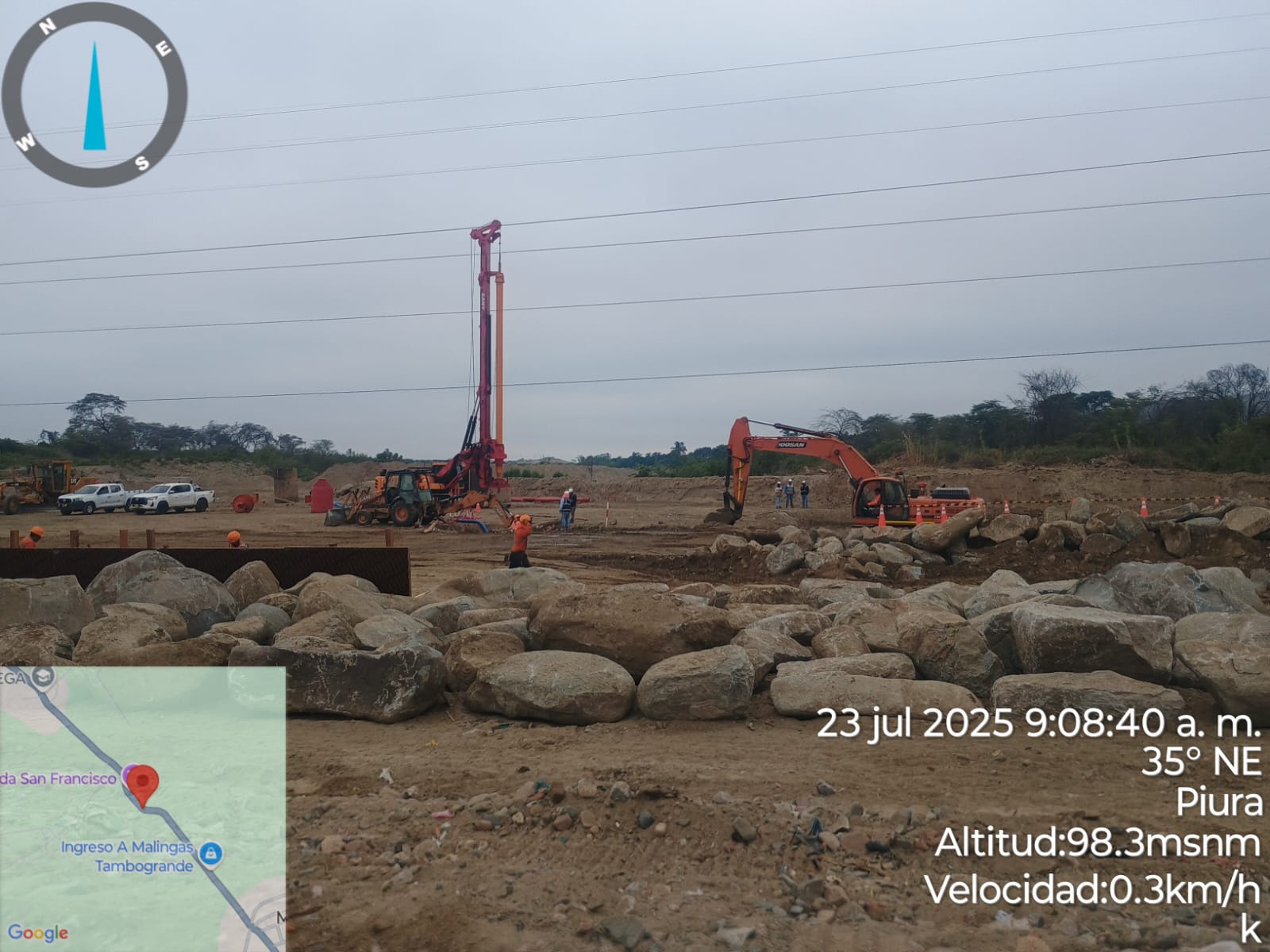
Malingas: ya se construyen las bases del puente San Francisco, el más largo del proyecto Once Puentes

Video y fotos exclusivas de Milton García.


Este martes 23 de julio, en un recorrido por la ruta Palominos–Malingas, en el distrito de Tambogrande (provincia de Piura),confirmamos que ya han comenzado las obras del puente San Francisco, la estructura más larga del proyecto vial conocido como “Once Puentes”.


Se construye sobre la quebrada San Francisco, entre los sectores Palominos y Malingas, y su ejecución representa un hito histórico para una de las zonas más productivas —y postergadas— de los valles de San Lorenzo y del Alto Piura.


Según se pudo constatar en el terreno, ya se está trabajando con maquinaria pesada en la preparación del cauce. Este paso era largamente esperado por la comunidad, que año tras año sufre el aislamiento durante las temporadas de lluvia, cuando las quebradas estacionales impiden el tránsito.


Desde la Municipalidad de Centro Poblado Malingas, informaron que el ingeniero residente de la obra ya se ha reunido con autoridades locales y que hay disposición para incluir a trabajadores de la zona durante la ejecución del proyecto. Esta coordinación inicial alienta expectativas de empleo y participación comunitaria, una demanda recurrente en este tipo de obras públicas.


Un puente clave en una historia mayor

El puente San Francisco tendrá aproximadamente 300 metros de longitud, lo que lo convierte en el más extenso de los once programados. Se trata de un componente estratégico, porque comunica directamente con Malingas, un centro poblado con alto valor agrícola, cultural y arqueológico, enclavado en la margen derecha del río Piura.


Malingas es reconocido por la producción de mango, limón y otros cultivos, y por su proximidad a sitios arqueológicos aún poco estudiados pero de gran potencial patrimonial.


La historia de la desconexión vial que sufre esta zona fue documentada en el reportaje que produjimos durante el verano para Epicentro TV. Puedes ver el video aquí:
🎥 https://www.youtube.com/shorts/Pb4okdA33vI


Temas por resolver

En paralelo, continúa pendiente un conflicto urbano en la ciudad de Tambogrande, donde se esperaba que se defina la situación legal de un centro nocturno que obstaculiza parte del trazado vial de otro de los puentes del proyecto, el Bonapira.


Mientras tanto, el inicio de trabajos en San Francisco marca un punto de inflexión: después de años de anuncios, ya hay obra en marcha. Y no es una obra cualquiera: es el puente más largo del proyecto. Uno que, cuando esté terminado, podrá cortar de raíz décadas de aislamiento estacional para cientos de familias.


domingo, 1 de marzo de 2020

Don’t mistake exactly like Sullana

This is a real story at the Peruvian Northern, where I live. I dont know if it happens to you, but I feel the smallest, furthest towns use to be the most proactive when it’s about recognizing and saving in every sense. It happens me with Malingas, Tambogrande District, it is beginning to happen me with Sapillica again, which I just have a journalistic relationship, where something happened this week that encourages particularily to me.


It was just the last Sunday when checking out the filtered messages on Facebook, I found one from José encalada, whom I have met 19 years ago, and who has been a Radio Cutivalú’s Correspondent in Sapillica during his lifetime. I was introduced to him while a trip with Margarita Rosa vega and the Tambogrande Collective, once we had the first news of non-formal mining activity out there the nascents of Chipillico River.


Then, José was our guide, although that was not my first time in Sapillica. Actually, this year marks two decades since I knew that beautiful place for the very first time. I worked for the Fe y Alegría’s Project in Malingas that time, and only by one school, located in Sesteadero, it was necessary to sspend three hours tripping by pick-up for doing paperwork.


Including the Catholic nuns I worked for, a Mississauga, Ontario-based stock broker named Matthew sammut came with us, whom I browsed many times on Facebook but I have not found yet. And the joke with Matt was he came ignoring much about Spanish, intended to learn Spanish, and got back not speaking more Spanish than some basic greetings and thanks. And as I was the only bilingual guy at the office, discounting the nuns, so match him to Nelson for the man doesn’t feel very isolated in some meaning.


What I remember much of that friendship with Matt is he taught me to read the NBCUniversal’s business channel CNBC stocks ticker running below the screen, and the trip to Sapillica, that was scored by Shania Twain’s hits, whose both resulted to be fans.


Matt didn’t let to take photographs of everything in Sapillica, especially the cattle gracing at the nearby hills to the town.
 “It’s great!,” he repeated once and once again.
Already in previous days, we tried to hik Malingas Mount,where the nuns have their convent – he was not tired to shot photos.
 “Do you feel this looks like something in North America?,” I asked.
“Yes… like… Montana.”


When we traveled to Sapillica, I didn’t ask him what it looked like but if that motivated him to come back further. He said yes, and that was one of many experiences those convinced me about an additional development possibility for those towns beyond agriculture and cattle – tourism. Of course I was not clear that time what kind of tourism, as I came to learn it 11 years later in Malingas, but there was a chance, indeed, and that increased me the pride about that Piura where the Andes start to rise. [Check out Matt’s YouTube channel] 


As everybody, the next one we learnd about Sapillica was the invasion and the infestation of the illegal mining, that instead to keep beauty the mountains and the forests, drill them with holes and tunnels every size. The today congressman Daniel Urresti interestingly worked for pacification in the zone due to the interdiction policy, for the Farmers’ Patrol took the control of the district later, at the point that nobody comes out to the street after nine at night.


But in July 2016, an urgent call put me over the track of a science I was starting to appreciate – archeology, and that has been one of the recurrent coverages of FACTORTIERRA.NET. Then, my partner Marco Paulini was beginning the journey to decrease the maternal mortality across Sapillica from three per year to zero –what he achieved and held until the Health officials decided not to hire him again—when he found a beautiful trace on the rock that made him to remember the sites we have identified and registered in Malingas. [Check out the full story] 


It’s about a big spiral on a 20-feet-height rock, just at the entrance of Loma Alta Village, Masías Bajo Community, that when he sent it, he put the whole newsroom on alert and eased next to other producer, estany Tineo, I traveled with to verify what seemed to be incredible on the photograph – A petroglyph! A more-than-touchable evidence of the Formative Age’s people needed to picture something on the rocks for marking something we are trying to understand since 11 years ago! [Check out the full story] 


In Malingas, we came to convince that work could be until 4000 years old, much more ancient than the Incas, the Aztecans, the Mayans! Anyway, could it happen the same in Sapillica? The first photographic and spectrographic analysis by the archeologist Daniel Dávila upon high-resolution images we got to take at that place leave the suspicion more than open, and a hypotheses for the moment: they could be part  of the so-called Samanga Tradition, in reference to the site at el Toldo Village, Ayabaca District, where the best conserved traces are located.


My initial reaction during the two trips I did to identify and register petroglyphs was notifying José encalada because, to begin, before than me, I ever tought he is the fair person who has to tell the world what we are finding. It’s his district, isn’t it?, I mean. What matters if I have or don’t have an interchange agreement with Cutivalú! The issue here is it must establish it exists, and it’s there when the journalism does one of its most wonderful works, increasing the science and the knowledge.


I never could met Pepe but I ever kept the connection, we ever have been in touch. I also have known his house and met his beautiful family that had me much kindly, what I will ever thank. And, look what nice the human relations are, Pepe call at my cellphone Sunday night to release me the story: “I was noticed about some petroglyphs in Pampa Verde.”


I confess I tried to hold moody, something it’s not happening while I write this op-ed, that I write pretty enthusiastic, but I was fascinated of the story, because it proves a work hypotheses launched by the same Sapillica people since the first time we arrived: the district is nailed by archaeological evidences. I have mentioned you Loma Alta, now Pampa Verde, that is in the occidental side, add Tunal in the southern side, and Trujillo, very close to the Sapillica Town. Is there much in that territory that is just over 150 square miles? We do suspect that. [Check out the story]  

The good to be in 2020 for Sapillica, for you, for our crew, and for me, is we are not in November 2009 anymore, when we started underground and following fake clues. Today we can say, almost not mistaking, the petroglyphs networks in Sapillica and Tambogrande could be connected, being part of one only way, that also disperses across Quiroz Valley, climbs up through Pacaipampa, reaches Huarinjas (Huaringas), passes over Sang Ignacio and Jaén, in Cajamarca, and could have one of its starting points in Luya, Amazonas, at the Peruvian Jungle highlans.


José, as well as us, has wondered to know more, to understand the message it has been kept (who knows) during four millennia on those rocks, to explain the district, the region, the country, and the world what they all are about and how it can evolve the history as it has been taught for decades. That would be a nice Project, actually, that the people of Sapillica must engine! Look at Malingas, where they are very motivated to retake it.


And while I look at Sapillica encouragingly, when I get back mentally to Sullana and I watch around, I can’t say the same. Here, in the second most important province of Piura Region, we are predating our past rather, as it happens in El Cucho, or we treat it indifferently, despite, as a colleague of mine whom I covered one of those stories told, there is evidence wherever you step on.


If Sapillica (and Malingas) gets to arrange an archaeological research and changes the History books, it will have something real to blame to Sullana everytime it wants because it will be a positive example that everybody will wish to imitate. And if the tourism comes in a planned, ordered manner, it would be much better. They really deserve it, and they have to work since today for that becomes another local economic axis.


Send me your comments to Facebook, Twitter, and LinkedIn.


domingo, 30 de junio de 2019

Something new comes for Malingas

This Sunday, June 30th, I’ve been coming back in Malingas, Tambogrande District, Piura Region (Peru), but I didn’t go alone. This time, we have joined a multi-talented crew with Francesco Navarrete, Daniela Peña, Robertson Vidarte, and Marco Paulini.


Francesco is an entrepreneur with so many skill to smell profitable business opportunities, Daniela is specializing in architecture and urbanism, Robertson is a young promise of photography, videography, and graphic design, and Marco is a specialist in public health projects, author and coach too, whom I shared other spaces as the generation of scientific contents for FACTORTIERRA.NET and the management of One Billion Rising initiative in Piura.


All this crew atended by an invitation from the Malingas Town’s Mayor Jesús María García, who became notorious during the 2019 rainy season in Peru when she used the social media for claiming government relief once her community formed by more than 20 villages got isolated because of a San Francisco Creek’s overflow, a Piura River tributary.


The work of this Sunday has been a first approaching to the people’s expectations, and what comes in the next months is a sucession of activities looking for the benefit and the projection of Malingas abroad, and that we’ll be updating you about constantly. Meanwhile, among these lines, we share some photographs of today’s meeting.


Algo bueno viene para Malingas

Este domingo 30 de junio he estado de regreso por Malingas, en el distrito de Tambogrande, Piura; pero no he ido solo. Esta vez hemos formado un equipo “multitalentos” integrado por Francesco Navarrete, Daniela Peña, Robertson Vidarte y Marco Paulini.


Francesco es un emprendedor con mucho olfato para identificar oportunidades rentables de negocio, Daniela está especializándose en arquitectura y urbanismo, Robertson es una joven promesa de la fotografía, la videografía y el diseño gráfico, y Marco es especialista en proyectos de salud pública, además de autor y capacitador, con quien he compartido otros espacios como la generación de contenidos científicos para FACTORTIERRA.NET y la gestión de la iniciativa Un Billón de Pie en Piura.


Todo este equipo acudió por invitación de la alcaldesa del centro poblado Malingas, Jesús María García, quien alcanzara notoriedad durante el periodo lluvioso de 2019 en Perú, al usar las redes sociales para pedir ayuda gubernamental una vez que su comunidad compuesta por más de 20 localidades se quedó aislada debido a la crecida de la quebrada de San Francisco, un afluente del río Piura.


El trabajo de este domingo ha sido un primer acercamiento a las expectativas de la gente, y lo que se viene en los próximos meses es una serie de actividades que buscarán el beneficio y la proyección de Malingas en todas las esferas, y de lo que estaremos actualizándoles constantemente. Mientras tanto, entre estas líneas, compartimos algunas fotografías de la reunión de hoy.


miércoles, 15 de febrero de 2023

Las alteraciones del orden son mal negocio

  • Las protestas antigobierno en la ciudad de Piura causan alarma.
  • En Sullana, grupos de motorizados inquietan a toda la ciudad.
  • Y en Tambogrande, tienen 4000 años… y no pasan de moda.


Protesta

El 13 de febrero, manifestantes que se identificaron como ronderos de la sierra de Piura bloquearon la Carretera Interoceánica Norte. La protesta impidió que la ciudad de Piura se conecte con las provincias de Morropón y Huancabamba. Y a través de esta misma vía con toda la selva norte del Perú.

Adicionalmente, impidió que las provincias de Morropón y Huancabamba transiten libremente hacia toda la costa del Perú.

Esto también impide que la sierra de Piura y la selva norperuana envíen sus mercancías a Paita, desde donde se exportan al mundo.


Estamos atentos a nuevos desarrollos. Sígueme como @nelsonsullana. Para ampliar, reproduce el video al inicio de esta entrada.


Piques:

Un grupo de motorizados altera la tranquilidad en el área metropolitana de Sullana. Son unos 20 jóvenes compitiendo informal o ilegalmente en carreras de motocicletas. Son los llamados “piques”.

El problema es que usan cualquier calle o avenida para montar sus competiciones: Jardín, Santa Rosa, López Albújar, Santa Teresita y hasta el centro de Sullana se han convertido en sus circuitos de carreras y piruetas.

El vecindario está mortificado por el ruido de los escapes. Además por la velocidad que desarrollan las máquinas: podrían poner en riesgo la vida de los y las transeúntes o mascotas.


Te actualizaré esta historia conforme hayan desarrollos. Sígueme en las redes sociales. Me hallas como @nelsonsullana. Para ampliar, reproduce el video al inicio de esta entrada.


Turismo:

Tienen unos 4000 años de antigüedad y salieron de paseo. Se trata de los petroglifos de Malingas. Esta muestra de arte rupestre fue tema de un carro alegórico.

Fue confeccionado por la Municipalidad de Centro Poblado Malingas y participó del corso de carnaval organizado por la Municipalidad Distrital de Tambogrande, aquí en la costa de Piura.

La alegoría presentada por Malingas incluyó una referencia a la quebrada de san francisco, su principal fuente de agua.


Si quieres visitar la zona, contáctame en mis redes sociales.

Me encuentras como @nelsonsullana. Para ampliar, reproduce el video al inicio de esta entrada.

Y si quieres ver cómo quedó el carro alegórico de Malingas, además de conocer toda la investigación arqueológica, entra a factortierra.blogspot.com